The key points
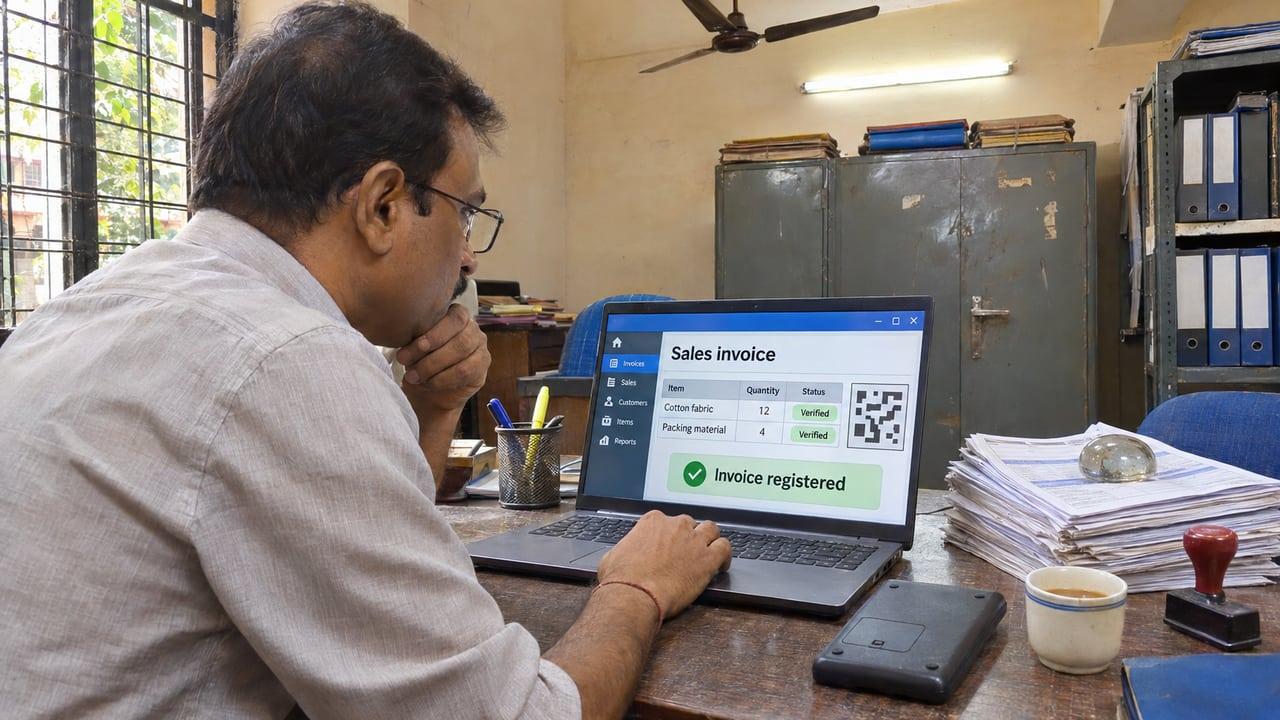
- E-invoicing does not mean the government creates your invoice. Your own software creates it and reports it to an Invoice Registration Portal.
- The threshold has been five crore rupees aggregate turnover since 1 August 2023, measured on any year from 2017-18 onwards.
- B2B invoices, credit and debit notes, exports and SEZ supplies are covered. Sales to consumers are not.
- Businesses at ten crore rupees and above must report each e-invoice within thirty days, or the portal will not issue the IRN.
What is GST e-invoicing, in plain terms?
It is reporting, not a new way of writing invoices. GSTN's own overview puts it clearly: taxpayers keep creating invoices in their own accounting, billing or ERP systems, then report them in a standard format to one of six government-authorised Invoice Registration Portals. The portal validates the invoice and returns it signed, with a unique Invoice Reference Number and a QR code.
That returned IRN is what makes the invoice legally usable. GSTN states that a GST invoice for a B2B transaction is valid only with a valid IRN. If your system prints and sends the invoice before it has an IRN, your customer may not be able to claim input tax credit on it.
Generating IRNs on the portals is free. What costs money is the integration: getting your billing software or ERP to send the invoice, handle errors and store the response.
Does my business cross the threshold?
Check turnover the way the rule does. It is aggregate turnover across every GSTIN registered under your PAN, across India, and it counts if you crossed the limit in any preceding financial year since 2017-18. A business that dipped below five crore rupees last year but crossed it three years ago is still in.
The threshold came down in steps over several years and has been five crore rupees since 1 August 2023, under Notification 10/2023 Central Tax. Many owner-run businesses crossed it without noticing that a reporting duty came with it. Note that the e-invoice portal enabling your GSTIN does not by itself mean you are legally required to e-invoice. Turnover decides that.
- Add turnover across all GSTINs under the same PAN
- Check every financial year back to 2017-18, not only the latest
- Confirm whether your category is exempt before assuming you are covered
Which invoices are covered, and which are not?
The mandate covers business-to-business and business-to-government invoices, credit notes and debit notes, supplies to SEZ developers, exports and deemed exports. Business-to-consumer sales, imports and job work are not covered under the current mandate.
That distinction matters for software choice. A retail counter or a restaurant selling to walk-in customers issues mostly consumer invoices, so the e-invoicing module may matter less than the GST logic on the bill itself. A distributor or manufacturer billing other businesses needs it on almost every document. If you sell both ways, the software must recognise which invoice needs an IRN and which does not, without someone deciding by hand.
Some classes of taxpayer are exempt under Rule 48(4): banks, insurers and other financial institutions including NBFCs, goods transport agencies, passenger transport services, cinemas for admission tickets, and SEZ units. SEZ developers are not exempt.
What is the thirty-day reporting rule?
From 1 April 2025, taxpayers with aggregate annual turnover of ten crore rupees and above cannot report an e-invoice more than thirty days after its invoice date. The rule applies to invoices, credit notes and debit notes, and once the window closes the portal blocks IRN generation for that document.
This is where manual workflows break. If invoices are raised in billing software and then batch-uploaded by an accountant at month end, a single late batch can leave invoices that can no longer be registered. Automatic reporting at the moment of invoicing removes that risk.
What should I ask a billing software vendor?
Ask how the software reports to the portal and what happens when reporting fails. Good systems call the IRP through an API or a registered GST Suvidha Provider, show the IRN and QR code on the printed invoice, and queue failed submissions with a clear error instead of silently printing an invalid invoice.
For off-the-shelf billing tools, the questions are mostly about reliability. For restaurant billing and POS software, check how it separates consumer bills from the occasional B2B invoice to a corporate customer. For a custom system built around your process, plan e-invoicing as part of the invoice workflow from the start, because retrofitting it means changing numbering, cancellation and credit-note logic.
How e-invoicing applies by type of business
| Business type | Typical invoices | E-invoicing impact |
|---|---|---|
| Distributor or manufacturer | Mostly B2B | Applies to nearly every invoice once over the threshold |
| Restaurant or retail counter | Mostly to consumers | Consumer bills are not covered; occasional B2B invoices are |
| Exporter | Export invoices | Covered, with or without payment of tax |
| Service business billing companies | B2B services | Applies once over the threshold |
| Bank, insurer, NBFC, transport agency | Various | Exempt class under Rule 48(4) |
E-invoicing readiness checklist
- Aggregate turnover checked across every GSTIN under the PAN since 2017-18
- Exemption status confirmed for your category
- Software reports to an IRP automatically, not by manual upload
- IRN and QR code print on every covered invoice
- Failed reports are queued and visible, never silently skipped
- Credit notes and cancellations follow the same reporting flow
- Thirty-day window monitored if turnover is ten crore rupees or more
Sources
Rules and guidance this answer relies on. Policies change, so check the current version before acting on it.