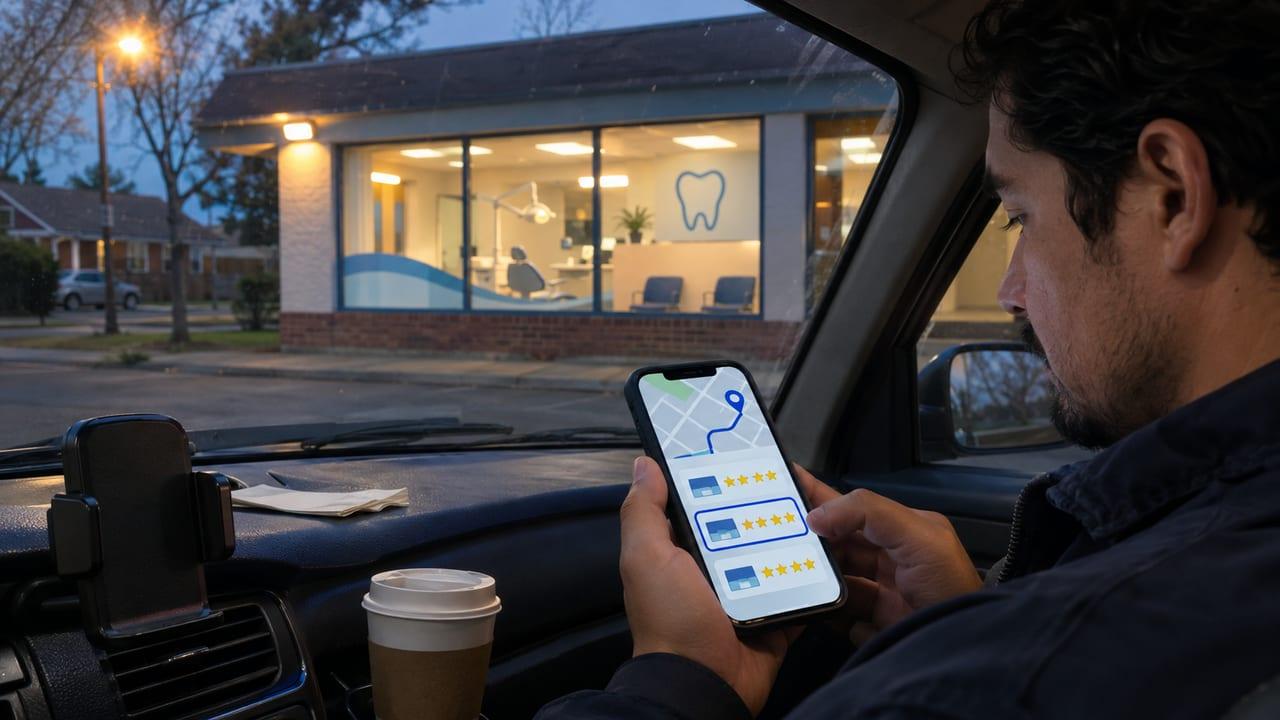
The key points
- Google ranks local results on relevance, distance and prominence.
- Your primary Business Profile category is one of the biggest choices you'll make.
- Reviews must be genuine and unfiltered; incentives break Google's rules.
- Measure booked appointments from search, not rankings alone.
How does Google decide which dentists appear in the map results?
Google says local results are based mainly on relevance, distance and prominence. Relevance is how well your profile and site match the search; distance is how far you are from the searcher or the place they named; prominence is how well known and well reviewed you are. You control the first and third. You can't move the building.
That last point explains a lot of frustration. A practice on the edge of town will rarely appear for 'dentist near me' searched from the other side, however good its SEO. What it can win is searches for treatments it's genuinely strong in, from people willing to travel for them: implants, sedation, clear aligners, sleep appliances.
Dental SEO, then, is two jobs running together. Make your Business Profile and website the clearest, most trusted answer near you, and build depth in the treatments where you can draw patients from further away.
Which Google Business Profile categories should a dental practice choose?
Choose the primary category that describes the practice as a whole (usually Dentist or Dental clinic), then add a small number of secondary categories for services you genuinely offer, such as Cosmetic dentist, Emergency dental service, Pediatric dentist or Orthodontist. Google's guidance is to pick the most specific category that fits and a few more that describe your core business, not every service you offer.
Resist adding every category on the list. A general practice listing Endodontist and Periodontist because one associate does some root canals muddies relevance and can mislead patients looking for a specialist. If a specialist is registered as one in your country and practises from your location, that's what their practitioner profile is for.
- Business name exactly as it appears on your signage, with no added keywords
- Address and service area accurate, phone answered by the practice
- Hours kept current, including special hours for holidays
- Services and treatments listed with plain descriptions
- Real photos of the exterior, reception, surgeries and team
- Booking link pointing to your own booking page
Should each dentist at the practice have their own Google profile?
Google allows public-facing practitioners such as dentists to have their own Business Profile, separate from the practice's profile, if they can be contacted at the verified location during stated hours. When several dentists work at one location, the practice should have its own profile and each practitioner's profile should carry only their name.
Practitioner profiles can help a well-known dentist be found by name, and they collect their own reviews. They can also split reviews and confuse patients, especially when an associate leaves and the profile lingers. Decide deliberately, keep a list of who has a profile, and handle departures promptly. A solo dentist who is the practice usually needs only one profile.
How should a dental practice get more Google reviews?
Ask every patient, consistently, at the moment they're most satisfied, and make it easy with a direct link or QR code at reception and in a follow-up message. Then reply to reviews, good and bad, without disclosing anything about the patient's care.
The rules are firm. Google's content policy prohibits offering incentives for reviews and prohibits selectively asking only happy patients (often called review gating). In the US the FTC's 2024 rule on consumer reviews and testimonials made fake reviews and suppressing negative ones unlawful. And in reply to a critical review, confirming someone was your patient can itself be a privacy problem in many countries. Thank them, invite them to call, and take it offline.
What does a dental website need for local SEO?
Clear treatment pages, dentist profiles that show expertise, consistent contact details, Dentist structured data and fast mobile pages. The website is where Google confirms what your profile claims, and where patients decide whether to book.
Treatment pages carry most of the weight for searches beyond 'dentist near me'. A page on dental implants that explains who is suitable, the consultation and CBCT scan, the stages and healing time, alternatives and risks, and which dentist provides it is far more useful than a generic paragraph. Health content is treated as high stakes, so show who wrote or reviewed it.
Location pages are worth having only for places you actually serve with something specific to say: a second surgery, parking and access details, which dentists work there and which treatments are offered. Thirty pages that swap the suburb name are a city-page factory, and Google's spam policies describe doorway pages of exactly that kind.
- Dentist or LocalBusiness structured data with name, address, phone, hours and geo coordinates
- One page per treatment you want to grow, reviewed by a dentist
- Profiles linking each dentist to the treatments they provide
- Name, address and phone identical to the Business Profile
- Embedded map and directions on the contact page
How do you measure whether dental SEO is working?
Track the actions that lead to appointments: calls from the Business Profile, clicks to book, website form submissions and booking completions, and, where your system allows it, which new patients came from search. Rankings are a symptom; appointments are the result.
Set up conversion tracking in GA4 for form submissions and booking clicks, use call tracking carefully (keep your main number consistent on the profile and add a tracking number as the additional number), and ask new patients at check-in how they found you. Review the trend over months. Local SEO compounds slowly, and week-to-week movements are mostly noise.
A first-month local SEO plan for a dental practice
Claim and audit the profile
Confirm ownership of your Google Business Profile, fix the name, primary category, hours, phone and booking link, and add real photos.
Fix your details everywhere
Make name, address and phone identical on the website, profile and the main directories and dental listings in your country.
Start a review routine
Ask every patient with a direct link, never with incentives or only the happy ones, and reply to each review without patient details.
Upgrade three treatment pages
Pick the treatments you most want to grow and rewrite them in the patient's words with a dentist's review.
Add structured data and tracking
Add Dentist schema, set up GA4 key events for bookings and forms, and record how new patients found you.
Local SEO for dentists checklist
- Is your primary Business Profile category Dentist or Dental clinic, with only relevant secondaries?
- Does your profile name match your signage exactly?
- Do you ask every patient for a review, with no incentives?
- Do your top treatments each have a detailed, dentist-reviewed page?
- Is Dentist structured data on the site and correct?
- Can you count booked appointments that came from search?
Sources
Rules and guidance this answer relies on. Policies change, so check the current version before acting on it.
- Google Business Profile Help: Tips to improve your local ranking on Google
- Google Business Profile Help: Guidelines for representing your business on Google
- Google Business Profile Help: Manage your business category
- Maps User Generated Content Policy Help: Prohibited and restricted content
- Google Search Central: Local business structured data