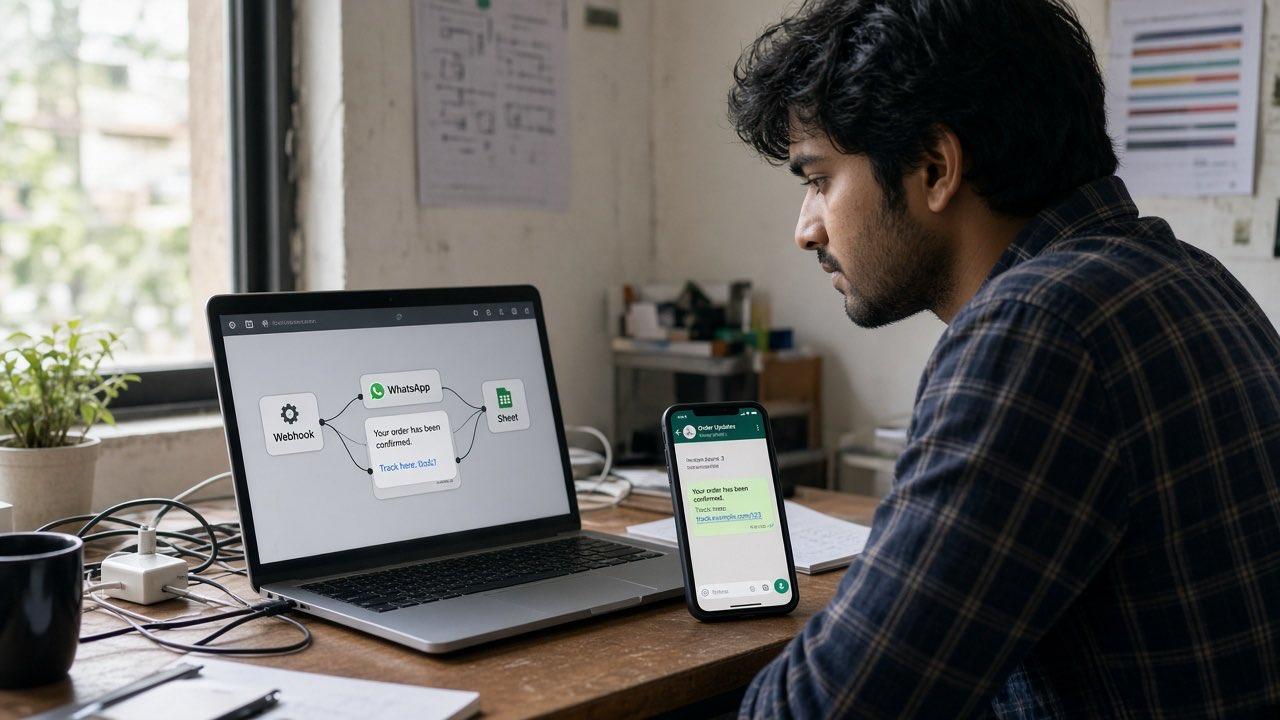
The key points
- n8n bills one execution per workflow run however many steps it has. Make bills credits per module run, and Zapier bills a task per successful action step.
- Zapier lists two WhatsApp triggers, new message and message status updated. n8n's trigger also covers template and account events.
- Only template messages can be sent once the 24-hour customer service window has closed, in every tool.
- The webhook, not the tool, is where WhatsApp automations break. Acknowledge fast, dedupe on the message id and keep a record of every delivery.
What do the three tools support natively for WhatsApp?
n8n has two WhatsApp nodes. The WhatsApp Business Cloud node sends messages, sends templates, and uploads, downloads and deletes media. Its Send and Wait for Response operation pauses a workflow until a person approves, types a reply or fills a form. The WhatsApp Trigger node starts a workflow on incoming messages and on account, phone number, template status, template quality and template category updates, which is useful when a template rejection should alert someone before a campaign day.
Make's WhatsApp Business Cloud app uses instant modules, which are webhooks that start a scenario as soon as WhatsApp reports a change. You choose the events to watch when you create the webhook. Its actions cover sending messages and template messages, media upload and download, and business profile changes.
Zapier's WhatsApp Business integration is the smallest of the three: two triggers (New Message Received, Message Status Updated) and three send actions (freeform, media and template), plus an attachment lookup. Zapier notes that a successful send response does not guarantee delivery, so the status trigger is how you confirm it. For anything outside those six operations, n8n offers an HTTP Request node that reuses your WhatsApp credential to call the API directly.
How does the 24-hour window change the workflow design?
Meta's messaging documentation says a 24-hour timer called the customer service window starts when a user messages you, and resets each time they contact you again. Inside it you can send free-form messages without pre-approval. After it closes you can only send pre-approved templates.
That rule belongs in the workflow, not in someone's memory. A reply flow checks when the customer last wrote. If the window is open it sends a free-form message, and if it has closed it sends a template. Zapier builds the same check into its freeform action, which only sends within 24 hours of the customer's last message. In n8n and Make you build the branch yourself, which takes one condition node and gives you the choice of what to do when the window has closed, such as queuing the reply for a person. What each template costs once it is sent is covered in WhatsApp Business API pricing in India.
How does each tool bill a WhatsApp message?
n8n's pricing page defines an execution as a single run of your entire workflow, and says step count and data volume do not change that. A flow that receives a message, looks up the customer, calls a model, writes to a CRM and replies is one execution. The standard self-hosted version is available on GitHub, so running it yourself replaces per-execution billing with hosting cost, which self-hosting n8n for business walks through.
Make's pricing page says credits are the billing unit, and every time a module in a scenario performs an action it consumes credits. Reading from a webhook, searching, creating and updating all count, and most actions use one credit. A WhatsApp scenario with five modules uses roughly five credits per message, so cost grows with both volume and the length of the scenario.
Zapier's task usage guide defines a task as any successful action that runs, and says trigger steps do not count. Filter and Paths steps are free as well. A Zap with a new-message trigger, a CRM update and a template reply uses two tasks per message. Each of the three models rewards a different design: fewer steps on Zapier, fewer modules on Make, and any number of steps on n8n.
Where do WhatsApp automations actually fail?
At the webhook. Meta's webhooks documentation treats any response other than 200 as a failed delivery, retries with decreasing frequency for up to seven days, and warns that retries can produce duplicate notifications. A workflow therefore acknowledges quickly, stores the message id, and ignores an id it has already processed. The same discipline is described in Stripe webhooks and idempotency in n8n.
n8n's trigger documentation adds two details worth knowing before you build. WhatsApp allows one registered webhook per app, so switching between test and production URLs overwrites the registered one. And publishing the workflow registers the URL but does not subscribe your app to the WhatsApp Business Account, so messages can fail to arrive without any failed execution to point at. Why WhatsApp webhooks fail gives the order to check these in.
Which one should you choose?
Choose Zapier when the job is a short chain, such as a new message creating a lead and a template confirming it, and the people maintaining it are not developers. Choose Make when you want visual scenarios and your volume and scenario length keep the credit count modest. Choose n8n when messages arrive at volume, when a flow has many steps, when you need code, retries and de-duplication, or when conversation data should stay on your own server.
Softivum builds WhatsApp automation on the Cloud API with n8n as the usual orchestration layer, in your Meta Business portfolio and under your WhatsApp Business Account. Workflow automation covers the build, and AI chatbots covers the conversational layer on top. For the general question across all kinds of automation, see Zapier, Make or n8n for automation.
n8n, Make and Zapier for the WhatsApp Cloud API
| Aspect | n8n | Make | Zapier |
|---|---|---|---|
| Incoming messages | WhatsApp Trigger node: messages plus template, phone number and account update events | Instant modules (webhooks) with the events you choose to watch | New Message Received and Message Status Updated triggers |
| Send a template | Send Template operation in the WhatsApp Business Cloud node | Template message action in the WhatsApp Business Cloud app | Send Template Message action |
| Free-form reply | Send operation, inside the 24-hour window | Send message action, inside the 24-hour window | Send Freeform Message, limited by Zapier to 24 hours after the customer's last message |
| Unit that is billed | One execution is one run of the whole workflow | Credits: modules that run consume credits, most at one credit each | Tasks: each successful action step is one task, and triggers are free |
Before you pick a tool for WhatsApp
- How many inbound WhatsApp messages a month, and how many steps does each one trigger?
- Does the reply flow check whether the 24-hour window is open before it sends?
- Does the workflow store the message id and skip duplicates?
- Will anyone need to be alerted on template rejection or quality changes?
- Does conversation data need to stay on your own server?
Sources
Rules and guidance this answer relies on. Policies change, so check the current version before acting on it.
- n8n Docs: WhatsApp Business Cloud node
- n8n Docs: WhatsApp Trigger node
- n8n: Pricing and execution definition
- Make: WhatsApp Business Cloud app
- Make: Pricing and credits
- Zapier: WhatsApp Business integrations
- Zapier Help: How is task usage measured in Zapier?
- Meta for Developers: WhatsApp messaging and the customer service window