How WhatsApp Business API pricing actually works
Understanding WhatsApp Business API pricing in India means separating three costs that get quoted as one: what Meta charges, what your provider adds, and what the integration costs to build. Most confusion comes from a provider quoting only the first and you discovering the other two later.
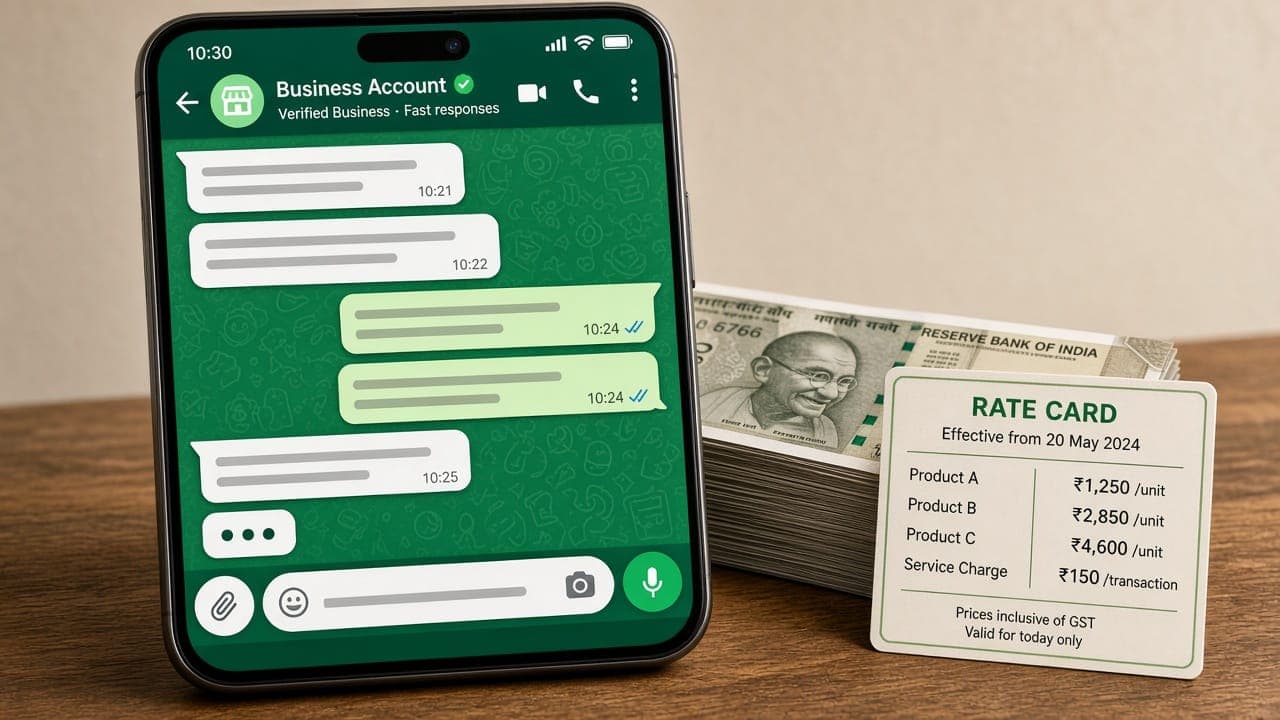
We build WhatsApp lead capture for clients in India, so this is written from working through the numbers on real projects. Two upfront warnings. First, Meta revises its rate card periodically, so treat any specific figure you read anywhere — including here — as needing verification against Meta's own pricing documentation before you budget. Second, a meaningful share of businesses asking about the API do not need it.
The three layers of cost
Layer one: Meta's per-conversation charge
Meta bills per *conversation*, not per message. A conversation is a 24-hour window, and everything inside it counts once regardless of how many messages pass.
Conversations are split into categories, and the category determines both the price and who can start it:
| Category | Who starts it | Typical use |
|---|---|---|
| --- | --- | --- |
| Service | The customer | Answering a question, handling a complaint |
| Utility | You | Order confirmed, appointment reminder, payment receipt |
| Authentication | You | One-time passcodes |
| Marketing | You | Offers, announcements, re-engagement |
Two structural facts matter more than the exact rates. Service conversations — the ones a customer starts — are free within a rolling window, which means inbound enquiry handling costs you essentially nothing. And marketing is the most expensive category, which is the opposite of how most businesses assume it works.
The practical consequence: the API is cheap if your use is answering people who contacted you, and expensive if your plan is to broadcast.
Layer two: your provider's margin
You cannot connect to the API directly in any practical sense. You go through a Business Solution Provider, and they add a margin on Meta's rate plus, commonly, some combination of:
- a monthly platform fee
- per-agent seats for the shared inbox
- a minimum monthly spend
- a one-off setup and verification fee
This layer is where quotes diverge wildly. Two providers advertising a similar per-message rate can land a long way apart once seats and minimums are counted. Ask for a total monthly figure at your expected volume and agent count, not a per-message rate.
Layer three: making it work with your business
The part nobody quotes. Getting the API connected gives you a channel; it does not give you a process. You still need:
- enquiries routed to whoever should answer them
- messages reaching your CRM so they are not trapped in one inbox
- templates written and submitted for approval
- follow-up sequences that stop when a human replies
This is the work we usually get called about, and it is where the value is. A connected API that still requires one person to watch a phone has not solved the problem it was bought for.
When the free app is the better answer
Being direct about this: if one or two people answer messages manually and enquiries are not getting lost, the free WhatsApp Business app is sufficient. It has quick replies, labels, a catalogue and away messages. It costs nothing.
Move to the API when one of these is true:
- Several people need the same inbox. The free app is tied to one device, and passing a phone around is not a system.
- Messages must reach your CRM. Enquiries living only on one person's phone are enquiries you cannot report on or follow up reliably.
- You need automation that runs unattended. Auto-replies, routing rules and follow-up sequences that fire whether or not someone is watching.
- You need to initiate at volume. Appointment reminders across hundreds of patients is not a manual job.
If none of those apply, you are buying infrastructure to solve a problem you do not have, and we will say so on a first call.
Where the money actually goes
Across the projects we have scoped, the cost profile is consistent and counter-intuitive.
Inbound-heavy businesses spend very little. A clinic or school answering enquiries pays almost nothing in conversation charges, because customer-initiated service conversations are free within the window. The bill is the provider's platform fee.
Reminder-heavy businesses pay predictably. Appointment confirmations and reminders are utility conversations, priced per conversation, and the volume is forecastable from your own booking numbers.
Marketing-heavy plans get expensive fast, then get throttled. Marketing is the priciest category, and if recipients block or report you, your quality rating falls and Meta restricts your daily messaging limit. So the expensive strategy is also the one most likely to stop working.
The optimisation follows from the structure: get customers to start conversations. A WhatsApp link on your website or in an ad opens a free service window and reaches someone who wanted to talk to you. That is better on cost and better on outcome than any broadcast.
Opt-in: the constraint that shapes everything
You cannot message someone who has not opted in, and "opted in" has a specific meaning: they gave you permission, on a channel where it was clear what they were agreeing to. A phone number collected for a delivery is not consent to receive offers.
This matters commercially rather than only legally, because it changes what the API is good for. It is excellent at deepening a relationship with people who already chose to hear from you, and poor at reaching people who did not. Businesses that grasp this build the opt-in into something the customer wanted anyway — an order confirmation, an appointment reminder, a delivery update — and earn the channel rather than buying it.
The practical route is to make WhatsApp the easiest way to reach you, then let the conversation start there. A click-to-chat link on your site, in your ads and on your invoices produces inbound service conversations, which are free, arrive from people with genuine intent, and open a window in which you can answer properly.
Template approval: the step that delays launches
Any message you initiate has to use a pre-approved template. You submit it, Meta reviews it, and until it passes you cannot send it. This is the step that most often delays a launch, because teams budget for the integration and not for the review cycle.
A few things make approval smoother. Templates must have a clear, specific purpose — a vague "we have news for you" reads as spam and gets rejected. Variables need to be genuinely variable rather than a way of smuggling arbitrary text past review. And the category you submit under has to match what the message actually does: labelling a promotional message as a utility notification is the most common rejection reason, and repeated attempts attract scrutiny rather than leniency.
Write and submit templates early, in parallel with the integration work. A rejected template can be revised and resubmitted, but each cycle costs days you will not get back at the end of a project.
Quality rating, and why broadcasting backfires
Every WhatsApp sender has a quality rating derived from how recipients react. Blocks and "report" taps lower it. When it falls, Meta reduces your messaging limit — the number of unique people you can message in a day — and it can be reduced repeatedly.
This is the mechanism that makes the obvious strategy fail. A business that buys the API to broadcast offers to a purchased list will see blocks immediately, watch its rating fall, and find its daily limit cut to a fraction of what it paid for. The channel is not SMS, and the audience treats it as personal space rather than a marketing surface.
What protects the rating is unglamorous: message people who genuinely opted in, give them something specific, make opting out easy and honour it immediately. Businesses that use WhatsApp primarily to answer people who contacted them rarely have a rating problem at all, which is another reason the inbound-first approach is both cheaper and more durable.
One practical consequence for budgeting: do not plan a campaign on the assumption that your messaging limit will grow. It grows with sustained good sending behaviour over time, not with spend.
Getting the numbers right before you commit
Four things to establish in writing:
- Your conversation mix. Estimate monthly volume by category. Your existing message history and booking numbers are usually enough to model this.
- The provider's all-in monthly total at that volume and your agent count, including seats, platform fee and any minimum.
- Who owns the number. It should be yours, with you able to move providers without changing it. Ask explicitly.
- What integration costs. The routing, CRM sync and sequences are a separate build from the connection.
On point three: a WhatsApp number your customers have saved is an asset. Losing it because a provider relationship ended is an expensive kind of avoidable.
What we build on top
The API is plumbing. What makes it worth having is what runs through it.
For most clients that means enquiries from WhatsApp, the website and ad platforms landing in one pipeline, qualified against rules, routed to the right person, and followed up automatically when nobody responds — which is what LeadFlow does. For businesses where the same questions arrive constantly, an AI chatbot trained only on verified content handles the repetitive share and hands anything unusual to a person.
WhatsApp is also where enquiries genuinely arrive in India, which is why it is built into how we approach clinics and training providers rather than treated as an add-on. On the WezvaTech training site, instant-response WhatsApp contact was the primary conversion route rather than a secondary one.
If you want to work out whether the API is worth it for your volume, that conversation is free and frequently ends with us saying the free app is fine.