The key points
- Delivery apps are a discovery and delivery channel; your own channel is a retention channel.
- On app orders the platform holds the customer relationship and pays the GST on restaurant service.
- Check your platform contract for price parity terms before pricing your own channel lower.
- An own channel only pays off with repeat customers and a delivery plan you can run.
What do delivery apps actually give a restaurant?
Three things that are hard to build alone: demand from people who were not looking for you by name, a delivery fleet, and a checkout customers already trust. For a new outlet, or a cuisine people browse for rather than search for, that discovery is worth a lot. Swiggy told the Competition Commission of India that its commissions vary with factors such as the restaurant's popularity, order volume, location and length of association, so the rate you pay is negotiated rather than fixed.
The trade-off is control. Customer contact details mostly stay with the platform. In the CCI case brought by the National Restaurant Association of India, Zomato said it stopped giving restaurant partners full access to customers' personal information in October 2018, citing user feedback about privacy. Whatever you think of that reason, the effect is that a customer acquired on an app is hard to reach again outside it.
What did the competition case look at?
In April 2022 the CCI found a prima facie case on some conduct by Zomato and Swiggy and directed its Director General to investigate. The order singles out wide price parity clauses, which stop restaurants offering lower prices on their own channels or other apps, and the conflict of interest when a platform favours restaurants it has a stake in. It also said that, on the facts before it, allegations about the level of commission and one-sided contract clauses did not appear to affect competition.
That is a fair summary of both sides: the regulator took the parity and neutrality concerns seriously, and declined to treat commission levels alone as a competition problem. For you, the practical point is to read your own contract. If it has a parity term, pricing your website lower may breach it, so compete on things the clause does not cover, such as combos, pickup convenience or loyalty.
When does your own ordering channel pay off?
When a meaningful share of orders come from people who already know you: office lunch regulars, families who order every weekend, customers who walk past daily. Those people do not need an app to discover you, and every order they place directly is one where you keep the relationship and the full bill.
It pays off less when you have no way to deliver, when most orders are first-time customers, or when nobody on the team can keep the menu and stock status current. A direct channel with stale prices or items that are out of stock does more harm than not having one.
Your own channel can be a simple ordering page on your website, ordering on WhatsApp, or both. If you are deciding between a full store and something lighter, our answer on whether to build an online store or sell through WhatsApp walks through that choice. For a build, see e-commerce development.
- Pickup orders are the easiest place to start, because they need no delivery fleet
- Put the direct ordering link on your Google Business Profile, receipts and packaging
- Keep one menu source so prices and availability match everywhere
How do Google and tax rules affect the choice?
Your Google Business Profile can carry ordering links. Google's help page explains that you can add custom ordering links, set a preferred provider for pickup and delivery, and remove a third-party provider; providers must remove their links within five business days of a request. Setting your own link as preferred for pickup is a quick win for regulars who search your name.
Tax differs by channel. Since January 2022, GST on restaurant service supplied through a delivery app is paid by the app under section 9(5) of the CGST Act, while orders on your own channel are taxed by you. Your billing system has to tag the source of every order, which our page on restaurant billing software and GST covers.
How do you run both without chaos?
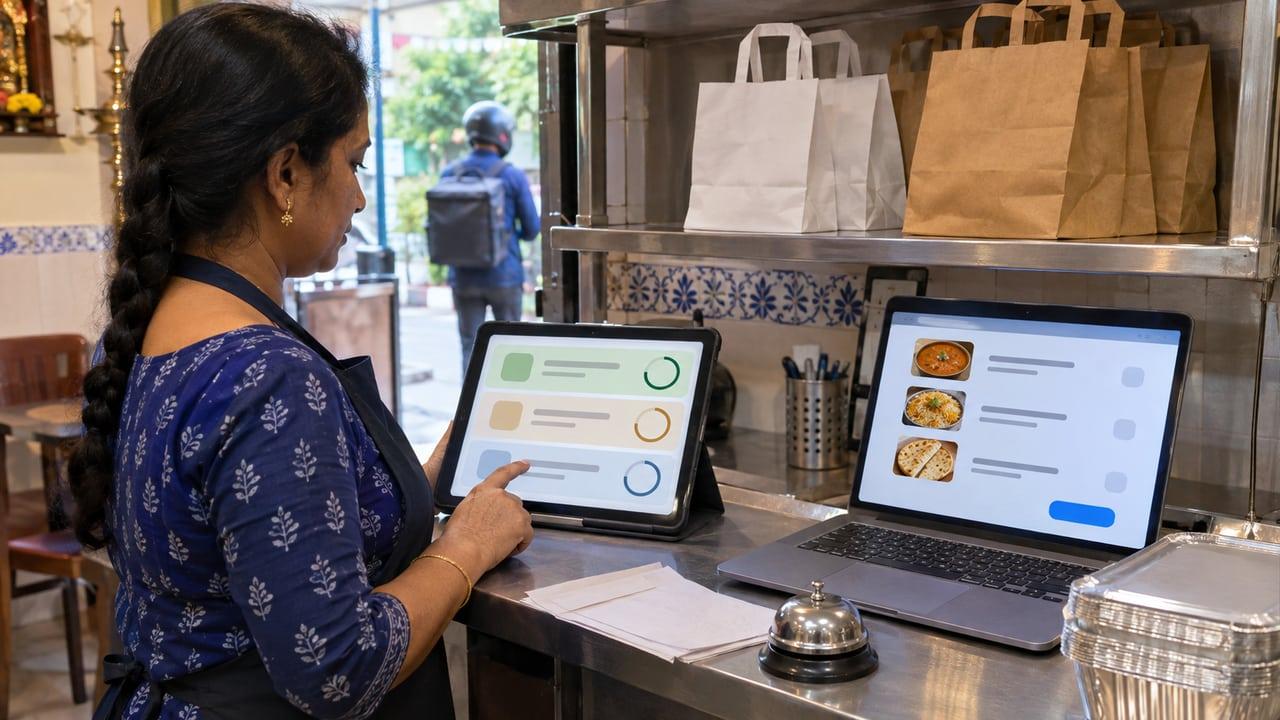
The kitchen should not care where an order came from. App orders, website orders and dine-in tickets should land in one queue, from one menu, with one stock count. That is the job of the POS, and it is where most restaurants lose time copying orders from tablets into the system by hand.
The restaurant POS software we build holds every channel in one kitchen queue, and the restaurants industry page covers the wider set-up. Start with pickup on your own channel, measure how many regulars use it, then decide whether direct delivery is worth adding.
Delivery apps compared with your own ordering channel
| Factor | Delivery apps | Your own website or WhatsApp |
|---|---|---|
| Finding new customers | Strong, through browsing and search inside the app | Weak until people know your name |
| Delivery | Handled by the platform | Yours to arrange, or pickup only |
| Customer contact details | Mostly held by the platform | Yours, with consent |
| Cost per order | Commission negotiated with the platform | Payment gateway fees and your own running costs |
| GST on the order | Paid by the platform | Charged and paid by you |
| Pricing freedom | May be limited by parity terms in your contract | Set by you, subject to those terms |
Before you launch your own ordering channel
- Read your platform contracts for price parity or exclusivity terms
- Decide whether you will offer pickup only or deliver yourself
- Make sure orders from every channel reach one kitchen queue
- Use one menu source for prices and availability
- Set your own link as preferred for pickup on your Google Business Profile
- Tag the order source in billing so GST is handled correctly
Sources
Rules and guidance this answer relies on. Policies change, so check the current version before acting on it.