The key points
- Ask for what your estimators need on the first pass, so the first reply is a quote rather than a list of questions.
- Accept drawings and models securely, and offer an NDA route for confidential work.
- Route by product line, region or process, and make ownership visible.
- Measure response time and win rate per source, not just the number of requests.
Why do generic contact forms lose RFQs?
Because a name, email and message box tells the estimator almost nothing, which is why form design matters more here than almost anywhere. The first reply becomes a set of questions, the buyer answers a day later, and meanwhile a competitor with a better form has already quoted.
Here's a common pattern. A buyer at an OEM sends the same drawing to four job shops on a Monday. Two reply asking for quantity and material. One replies with a quote on Wednesday. One never replies because the email went to a shared inbox nobody owned that week. The Wednesday quote has a strong chance, even if it isn't the cheapest, because the buyer has a deadline. Speed and completeness on the first response decide a lot of RFQs.
What should a manufacturing RFQ form ask for?
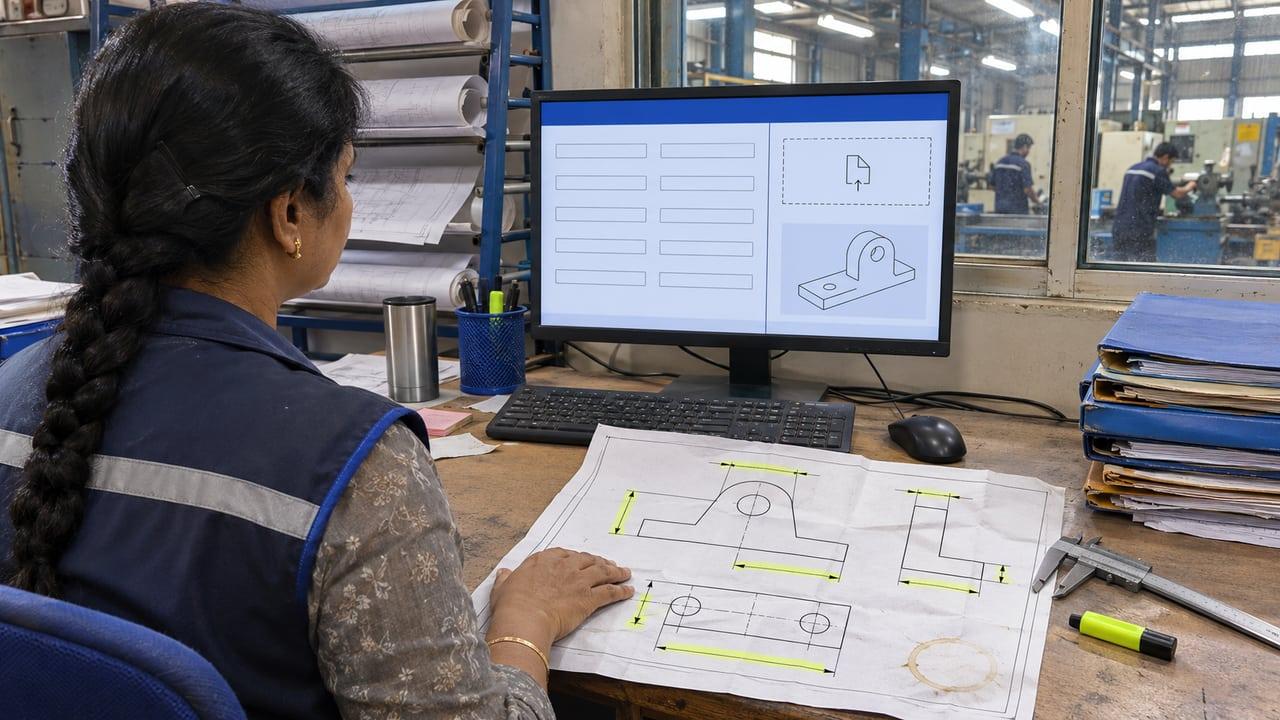
Ask for the details that change the price and the feasibility, and make the rest optional. A long form scares people off; a form missing the essentials creates back-and-forth. Sit down with your estimators and agree the fields together. The corporate site we built for a South Indian elevator manufacturer pairs its quote request forms with detailed product and safety specifications.
- Company, contact, country or region, and how they prefer to be contacted
- Part or product description, part number if it's a repeat or replacement
- Quantities, ideally several break points such as prototype, first batch and annual volume
- Material, grade, finish and any required standards or certifications
- Tolerances or a note that they are on the drawing
- Required delivery date and delivery location
- File upload for drawings and models
- Whether the work is confidential and needs an NDA before files are shared
How should drawings and CAD files be uploaded safely?
Accept the formats your engineers actually open, commonly PDF drawings, STEP and IGES models and DXF or DWG for 2D, and store them in a controlled location rather than as email attachments. Uploaded files are a security risk if handled carelessly, so treat them as untrusted.
OWASP's file upload guidance is a good baseline: allow only expected file types, check the type rather than trusting the file name, limit file size, rename stored files, keep uploads out of the public web folder, and scan them. Files should go to storage your team controls, with access limited to the people quoting. For confidential work, offer an NDA step before upload, or a way to request a secure upload link after one is signed. Customers in defense, medical or automotive supply chains may have their own rules about where drawings can be stored, so ask.
How should RFQs be routed and followed up?
Every RFQ should land with one named owner within minutes, with the files and details attached, and the buyer should get an immediate confirmation saying who will reply and roughly when.
Route by whatever decides who quotes: process, product family, region or account, a job workflow automation handles well. Push the request into your CRM so it becomes a tracked opportunity rather than an email. Set a reminder or escalation if nobody has replied within your target time. And keep the buyer informed if a quote will take longer, such as when material pricing or a subcontractor is involved; silence is what loses the job.
When does a manufacturer need CPQ software?
Configure-price-quote software helps when products are built from options with rules, and the price can be calculated from those options. It is less useful when every job needs an engineer to study a drawing.
If your sales team builds quotes in a spreadsheet that applies the same rules every time, that logic can usually move into a configurator or quoting tool, at least for standard products. For bespoke machining or fabrication, the better investment is often a clean RFQ intake and a quoting workflow in the CRM, plus templates that make the quote itself fast to produce. Commerce platforms also offer negotiable quotes, where buyer and seller adjust items, quantities and discounts until they agree.
How do you measure whether RFQs from the website are working?
Track three things: how many qualified RFQs arrive from each source, how long they take to quote, and how many become orders. Form submissions on their own say little about revenue.
Mark a successful RFQ submission as a key event in GA4 so you can see which pages and channels produce them. Then close the loop: when an RFQ becomes an order in the CRM, send that outcome back to your ad platforms. Google Ads supports importing offline conversions, so campaigns can learn from won work instead of every form fill. Over a few months, that tells you which products, pages and campaigns bring work worth having.
How to set up online RFQ handling
Agree the essential fields with estimators
List what they need to quote on the first pass and what can wait.
Build the form and secure upload
Support the file types you use, restrict and scan uploads, and store them where only the quoting team can reach them.
Route each request to an owner
Send RFQs to the CRM with the files attached, assigned by product line, process or region.
Confirm and set a response target
Send an instant confirmation naming the next step, and escalate any request without a reply by your target time.
Track outcomes
Record quoted, won and lost in the CRM and feed won orders back into analytics and ad platforms.
RFQ setup checklist
- Does the form capture quantity, material, required date and drawings?
- Are uploaded files type-checked, size-limited, scanned and stored privately?
- Is there an NDA route for confidential work?
- Does every RFQ have a named owner within minutes?
- Does the buyer get an immediate confirmation?
- Are quote turnaround time and win rate tracked by source?
Sources
Rules and guidance this answer relies on. Policies change, so check the current version before acting on it.