How to compare billing software for restaurants
Every comparison of billing software for restaurants ends up as the same table: GST invoicing, inventory, reports, multi-outlet, loyalty. Every product ticks every row. The table is accurate and it tells you nothing, because the differences are in how well each thing works under pressure, and a checkmark cannot express that.
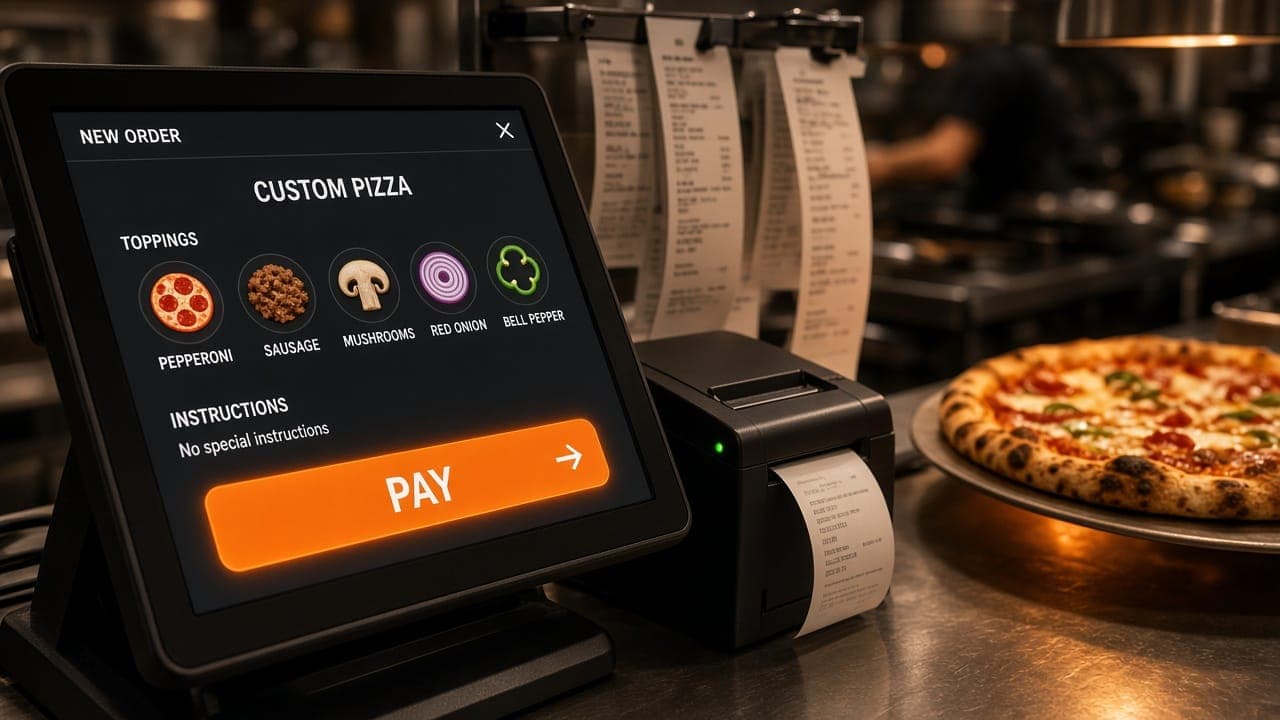
We built a POS and billing system end to end for a pizzeria, which is a specific and limited kind of authority: it means we made these decisions once, for one restaurant, and watched what happened. This is a framework for evaluating your own options, not a ranking of products we have not used in your kitchen.
Start by deciding what you are actually buying
Three different things get called billing software, and conflating them is the first mistake.
Invoice generation. Produces a compliant bill. That is all. Cheap, simple, and genuinely sufficient for a small operation with a fixed menu.
Billing plus counter management. Takes the order, produces the bill, handles modifications and splits. This is where most restaurants actually live.
Full POS. All of the above plus kitchen routing, stock decrementing from sales, expenses, staff permissions and reporting.
Work out which you need before looking at products, because a full POS sold to someone who needed invoice generation is an expensive way to be slower. Our page on what actually matters in POS software goes into the operational side; this one focuses on billing specifically.
The four criteria that decide adoption
1. Speed at the counter, on a complicated order
Not a simple order. Ask the vendor to book three items with one modification, add a fourth after a change of mind, then split the payment across two methods. Time it yourself.
This is the number that determines whether staff use the system or work around it. A system that adds twenty seconds per order during a rush will be bypassed within a week, and once staff are keeping a parallel paper record your reports are fiction.
2. GST handling for your actual registration
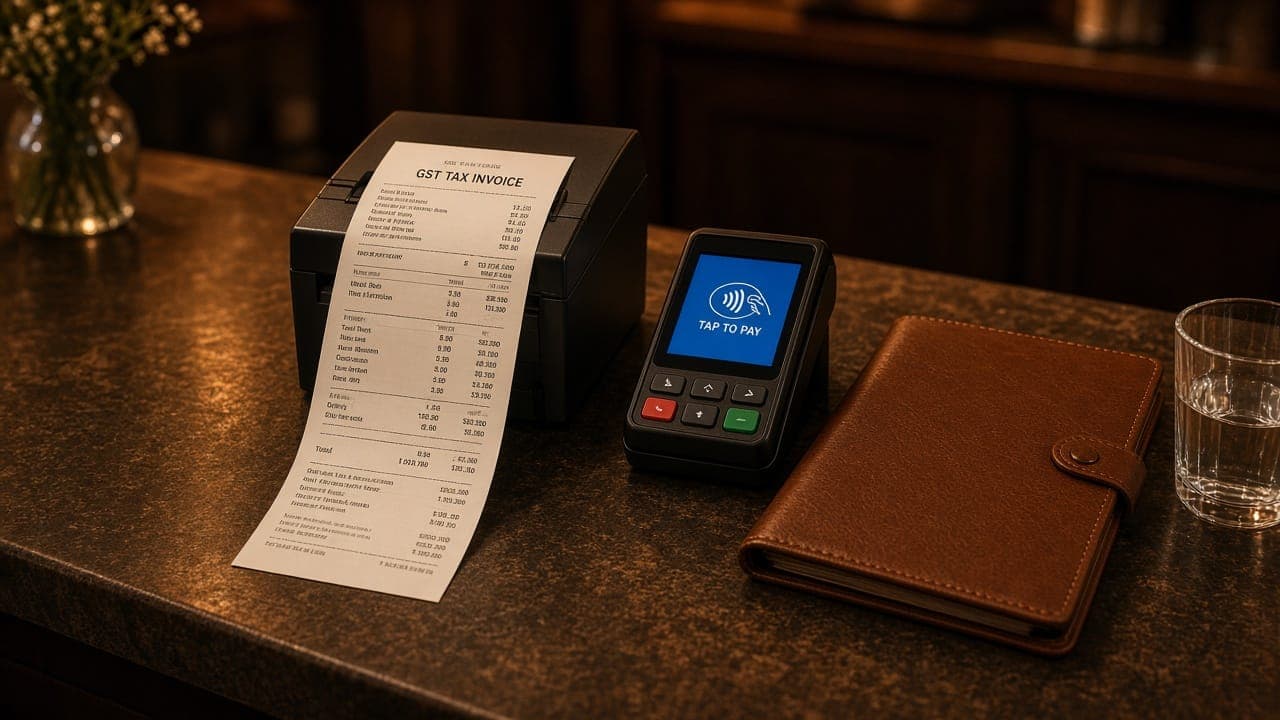
Restaurant tax treatment in India has enough variation — composition scheme or regular, dine-in versus takeaway, packaged goods alongside prepared food — that "GST compliant" on a feature page means very little on its own.
Take your own scenarios to your accountant with the product's sample invoices. Do not accept a checkbox. Invoice format errors are cheap to prevent and expensive to unwind across a year of filings.
3. Where payment sits relative to the kitchen
Most billing-first products treat the kitchen as an afterthought: the order is entered, the kitchen sees it, payment happens whenever. That sequence means every cancellation and mistaken order is absorbed as food already being cooked.
On the system we built the kitchen queue is gated on payment — nothing reaches the line until payment confirms. It sounds like trivial sequencing and it removes an entire category of waste. Ask where payment sits, and whether it can be changed.
4. The total cost including transaction fees
The subscription is the visible number. The card processing cut is often the larger one and is presented separately.
Work out your monthly card volume, apply each product's transaction rate, and add the subscription. A product that looks cheap monthly while taking a percentage of every card payment frequently costs more per year than a more expensive one that takes none. This calculation changes the ranking more often than any feature does.
A scoring table you can reuse
Take this into each demo and fill it in yourself rather than accepting the vendor's answers:
| Criterion | What to do | What good looks like |
|---|---|---|
| --- | --- | --- |
| Complicated order speed | Time three items, one modified, one added late, split payment | Under 15 seconds, comfortably |
| Correction flow | Void an item after it reached the kitchen | Possible, logged, does not need the owner |
| GST invoices | Show sample invoices to your accountant | Correct for your registration, unprompted |
| Offline behaviour | Ask them to switch the connection off | Orders queue locally and sync |
| Kitchen sequencing | Ask where payment sits in the flow | Configurable, and they have an opinion |
| Stock | Sell an item, check stock | Decrements automatically from the sale |
| Menu edits | Change a price yourself | You can, without raising a request |
| Permissions | Ask who can void and discount | Role-based, you draw the line |
| Total annual cost | Subscription plus transaction fees at your volume | Given in writing, in one figure |
| Data export | Ask for your sales history, now | Provided, in a usable format |
If a vendor resists more than one row, that resistance is the finding. The export row in particular: a product you cannot leave is one whose price will rise.
What "multi-outlet" should mean
If you run more than one location, or might, ask what consolidation actually looks like. There are two very different answers dressed in the same words.
The weak version is that each outlet runs its own installation and you log into each separately to see its numbers. That is not multi-outlet; it is several single-outlet systems and a spreadsheet at the end of the month.
The strong version is one system with outlet-level scoping: shared menu where you want it, local overrides where you need them, and consolidated reporting without manual assembly. The technical property is multi-tenancy, and it needs to be in the architecture rather than added later. It is the same reason we built tenancy into the school management platform from the first version — retrofitting how every record is scoped is a rewrite, not a setting.
What reporting should actually tell you
Every billing product advertises reports, and most produce a dashboard nobody opens after the first fortnight. Three numbers are worth having daily and are frequently absent or buried.
Item-level margin, not just item-level sales. Knowing you sold forty of something is half the picture. Knowing which forty items carry your margin, and which popular item is close to break-even after ingredient cost, is what changes menu decisions. This requires recipe-level stock, which is why that migration work pays for itself.
Voids and discounts by staff member. Not because you assume dishonesty, but because a pattern here is usually a training problem or a menu problem before it is anything else. A system that records who voided what, with a reason, surfaces it early.
Hour-by-hour sales. Staffing decisions come from this and almost nothing else. A daily total tells you the day was busy; an hourly breakdown tells you which two hours needed another person on the counter.
If a product cannot produce those three without exporting to a spreadsheet, its reporting is decorative. Ask to see each one during the demo, on their sample data.
The migration nobody budgets for
Switching billing software involves moving three things, and only the first is usually discussed.
Your menu. Straightforward, and vendors often do it as part of onboarding. Check whether modifiers, combos and variant pricing come across correctly rather than assuming, because those are where import scripts quietly drop data.
Your stock and recipes. Substantially harder. If you want stock to decrement from sales, someone has to map every menu item to its ingredients and quantities. This is genuinely useful and it is days of somebody's work, usually yours, because only your kitchen knows the real quantities.
Your history. Sales history generally does not migrate. You will have two systems for reporting across the changeover year, which is worth knowing before you plan a year-on-year comparison. Export everything from the old system before you cancel it, not after — access frequently ends with the subscription.
The practical advice is to switch at the start of a financial year if you can, and to keep read access to the old system for a month longer than you think you need. Neither costs much; both prevent the specific kind of problem that only appears at filing time.
Where custom becomes the better answer
Most restaurants should buy a product. Subscription billing and POS software is mature, well supported, and cheaper than building. We say this on first calls regularly.
Custom becomes worth considering in three situations:
Your flow is the advantage. A specific kitchen sequence, a particular notification pattern, a service model no product anticipated. If the thing that makes you better is the thing the software will not do, that is the case.
Licensing across outlets exceeds ownership. Per-outlet monthly fees across several sites, plus transaction cuts, reach the cost of owning a system faster than most operators expect. Run the five-year number.
You need modules products treat as edge cases. Expense tracking and recipe-level stock are usually thin in general billing products, and they are exactly where margin visibility comes from.
For the pizzeria, the deciding factor was the first: sub-ten-second booking and a payment-gated kitchen queue were the operational advantage, and no product did both. You can read what we built and why, or see how the operational system and the site that feeds it fit together for restaurants.
The shortest version
If you take one thing from this: go to the demo, book the most awkward order you can think of, and time it. Then ask for the annual total including card fees, in writing, and ask them to export your data in front of you.
Those three actions will separate the products more reliably than any feature comparison, and all three take under ten minutes.