The four questions every patient is actually asking
A dental clinic website has one job: convert someone who is already looking for a dentist into someone who books. That person is making a trust decision with almost no information, and they are asking four questions in roughly this order.
Who is going to be treating me, and are they qualified for this? What does the treatment actually involve, and will it hurt? Roughly what will it cost? And has this gone well for people like me?
A site that answers those four clearly converts. A site that opens with a smiling stock model, a mission statement about compassionate care, and a carousel answers none of them. We built the site for a multi-specialty dental clinic with nine MDS specialists and twenty-two services, and every decision came back to those four questions.
Question one: who will treat me?
This is where most clinic sites throw away their biggest advantage.
A practice with several specialists has a genuine, material edge over a single-dentist clinic: the implant is placed by someone who places implants, the child is seen by a paediatric specialist, the orthodontic case goes to an orthodontist. That is a real difference in outcome, and a patient will pay for it — if they know.
A page saying "our team of experienced professionals" communicates none of it. Individual profiles do: name, qualification, specialism, years practising, and the treatments that person handles. On a clinic site we built each of the nine specialists has their own profile, because the multidisciplinary team was the whole commercial proposition and a generic team page would have erased it.
If you have one dentist, this is still the answer. One named, qualified, visible person beats an anonymous practice every time.
Question two: what does the treatment involve?
Patients search for what hurts and what they are afraid of. They do not search for procedure names, and they certainly do not search in clinical language.
So treatment pages have to do two things at once: answer in the patient's words while demonstrating the clinical depth behind the answer. For each significant treatment, cover what the problem feels like, what the procedure involves in plain terms, how many visits, what recovery is like, and what the alternatives are.
The alternatives point is worth emphasising. A page that explains when a patient does *not* need the expensive option is more persuasive than one that only sells it. Patients can tell the difference, and the practice that told them the truth is the one they come back to.
Twenty-two treatment pages sounds like a lot. It is also twenty-two chances to be the page that answers the question somebody typed into Google at eleven at night.
Question three: what will it cost?
Most clinics publish nothing, on the reasonable grounds that treatment plans vary and a quoted figure could mislead.
The cost of that silence is higher than it looks. A patient with no price signal assumes the worst, or assumes you are expensive because you would not say. And you spend front-desk time on enquiries that were never going to proceed at your price point.
A "from" range with a clear explanation of what moves it does the work: it filters out mismatches, reassures the people who are a fit, and demonstrates that you are comfortable being asked. We take the same position on our own pricing, which is why that page explains cost drivers rather than showing nothing.
Question four: has this gone well for others?
Reviews matter more here than in almost any other sector, and they mostly live on your Google Business Profile rather than your site.
What the site can do is make the proof checkable. Real reviews with names where patients have consented. Before-and-after images where clinically appropriate and permitted. Specific statements about experience — years practising, treatments completed — rather than adjectives.
One warning, and it is the reason this site exists in its current form: do not invent any of it. Fabricated testimonials and invented statistics are the fastest way to lose the trust you are trying to build, and in healthcare they carry a professional risk beyond the commercial one. If you do not have real reviews yet, show nothing and go and ask your existing patients.
What to do about the fear
Dentistry has a problem almost no other clinical speciality shares at the same scale: a meaningful share of the people who need you are actively avoiding you. They are not comparing clinics. They are postponing.
A website can move some of those people, and almost none of them are moved by claims of gentle care. What works is specificity. Naming the thing — that many adults have not seen a dentist in years and are embarrassed about it — and saying what happens at a first appointment for someone in that position. What you will and will not do on the first visit. Whether you will lecture them. What the options are for anxiety management, in concrete terms rather than as a reassuring adjective.
This is uncomfortable copy to write because it means acknowledging that visiting you is unpleasant for some people. It is also, in our experience, the page that quietly earns the most difficult and most valuable appointments, because it is the only page on any clinic site in the area that spoke to the person reading it.
The mechanics that decide whether any of it works
Booking that works when the enquiry happens
The appointment a clinic loses is the one that occurred to someone late at night, when nobody is answering the phone and they resolve to call tomorrow, and then do not.
Booking that works out of hours, against your real availability rules, captures that. For clinics where the same questions arrive constantly, an AI chatbot trained only on your verified content handles the repetitive share and hands anything clinical to a person — which is the important boundary. A bot should never attempt diagnosis, and a well-built one says it will check with a colleague rather than guessing.
Speed on a mid-range phone
Patients research on phones, often on patchy connections. A clinic site that takes six seconds to become useful has lost people who never told you they were there.
Measure it with PageSpeed Insights rather than trusting your own office connection.
Post-treatment information, published
The same aftercare questions arrive repeatedly, and each one interrupts clinical time. Publishing post-treatment instructions answers them once, reduces call volume, and incidentally earns search traffic from people looking for exactly that.
Photography, and why stock imagery undercuts you
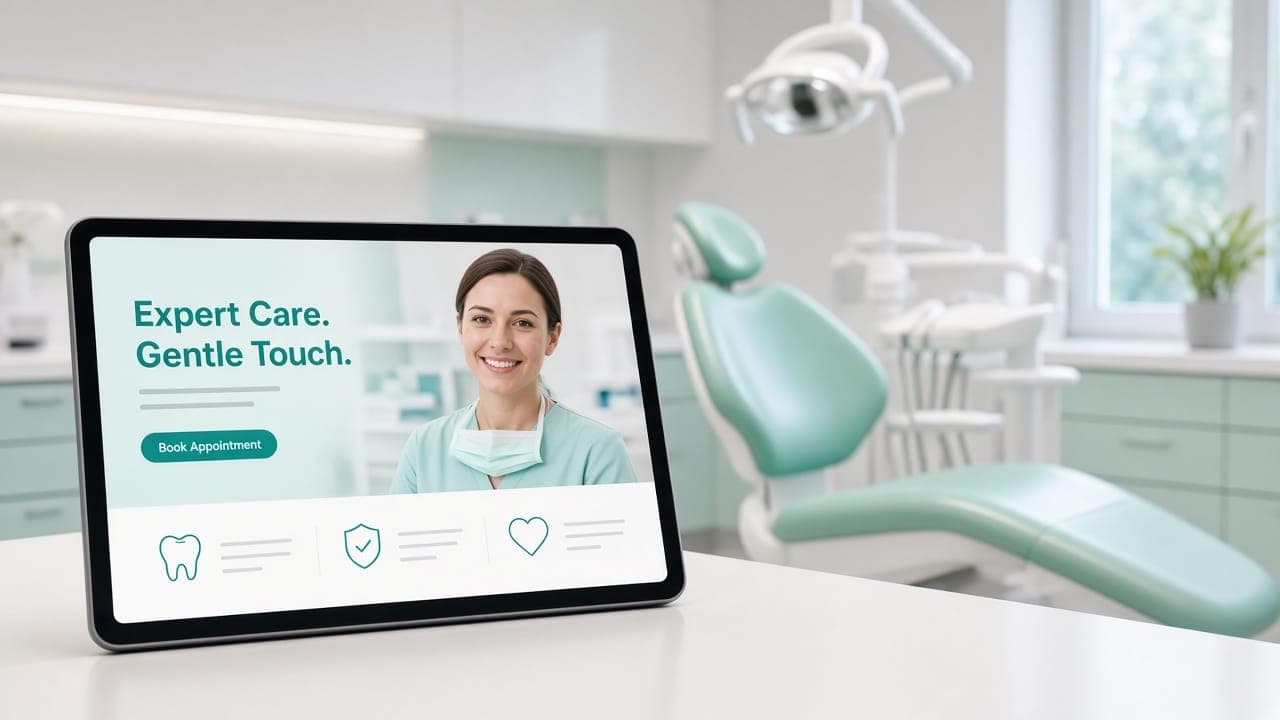
Almost every dental site in India uses the same handful of stock photographs: the white-toothed model, the gloved hands holding a mirror, the reassuring hand on a shoulder. Patients have seen all of them, on every clinic site they compared you against.
The effect is not neutral. It signals that there was nothing specific worth showing, and it means the one question photography could answer — what will this place actually be like — goes unanswered. A patient who is nervous about the visit is looking for the room, the chair, the reception, the faces of the people who will be there.
Real photography of the actual practice outperforms stock consistently, even when it is technically less polished. Your own reception, your own equipment, your own team. It does not need to be a professional shoot to beat a stock library, though one shoot is usually worth the money and gets reused for years.
Two constraints worth planning around. Get written consent before photographing patients, and do not photograph children without explicit parental permission in writing. And avoid before-and-after images unless they are your own cases, clinically appropriate to publish, and permitted by the relevant professional guidance — borrowed clinical images are the single riskiest content decision a practice can make.
Local search is doing more work than your website
For a clinic, most patient searches carry location intent, and the results are decided substantially outside your site: your Google Business Profile, consistent name and address details across the web, and review volume and recency.
That means a significant share of the work is not web development, and we would rather say so than sell you website changes to fix a profile problem. Claim the profile, populate it fully, add real photographs of the actual practice, and ask satisfied patients for reviews as a routine part of discharge.
What the site contributes is being the destination that converts the click once local search has produced it, and giving Google clear, structured information about who you are and where.
A checklist for your current site
Open your clinic's site on a phone and check:
- Can a patient see who would treat them, by name and qualification, within two taps?
- Does each significant treatment have its own page, in patient language?
- Is there any price signal at all?
- Can someone book, or at least enquire, without phoning during office hours?
- Is there real, attributable proof — or invented testimonials that should be removed today?
- Does it become useful in under three seconds on a mid-range Android handset?
- Is your Google Business Profile claimed, complete, and showing real photographs?
If more than two of those are a no, the site is losing patients who had already decided to look for a dentist. More on what we build for clinics, or our work for how this has played out in practice.