The key points
- A stored chat is personal data when the person can be identified from it.
- Consent has to be specific to the purpose you stated, and the notice comes with the request.
- A later campaign, or training a model on old chats, is a new purpose.
- The website DPDP duties and the chat duties are the same Act, applied at a different collection point.
Does a stored chat count as personal data?
Yes, when you can tell who the person is from the chat or from something you store next to it. A phone number, a name, a resume, or a thread you can match back to a customer is personal data under the Act: data about an individual who is identifiable by or in relation to that data. Processing includes storage, so keeping the transcript is processing, even if nobody reads it again.
A chat that never asks who the person is, and that you cannot tie to an account, is a narrower case. Most business bots are not in that case, because the point of the bot is to reply to a known customer. What the DPDP Act means for a business website is the same duty at a form. The chat is another collection point, not a separate regime.
What has to happen before the bot stores the chat?
Section 4 of the Act says you process personal data only for a lawful purpose, and only with the person's consent or for certain legitimate uses. Section 6 says consent is free, specific, informed, unconditional and unambiguous, given by a clear affirmative action, and limited to the data necessary for that purpose. Section 5 says the consent request is accompanied or preceded by a notice of the personal data and the purpose, how the person can withdraw consent and use your grievance redressal, and how to complain to the Data Protection Board of India. Section 7 lists legitimate uses that need no consent, including data a person gives voluntarily for a specified purpose and does not indicate they refuse. Whether a support chat fits that use is a question for your adviser. The notice in the chat is still the safer default, and it is the one to build.
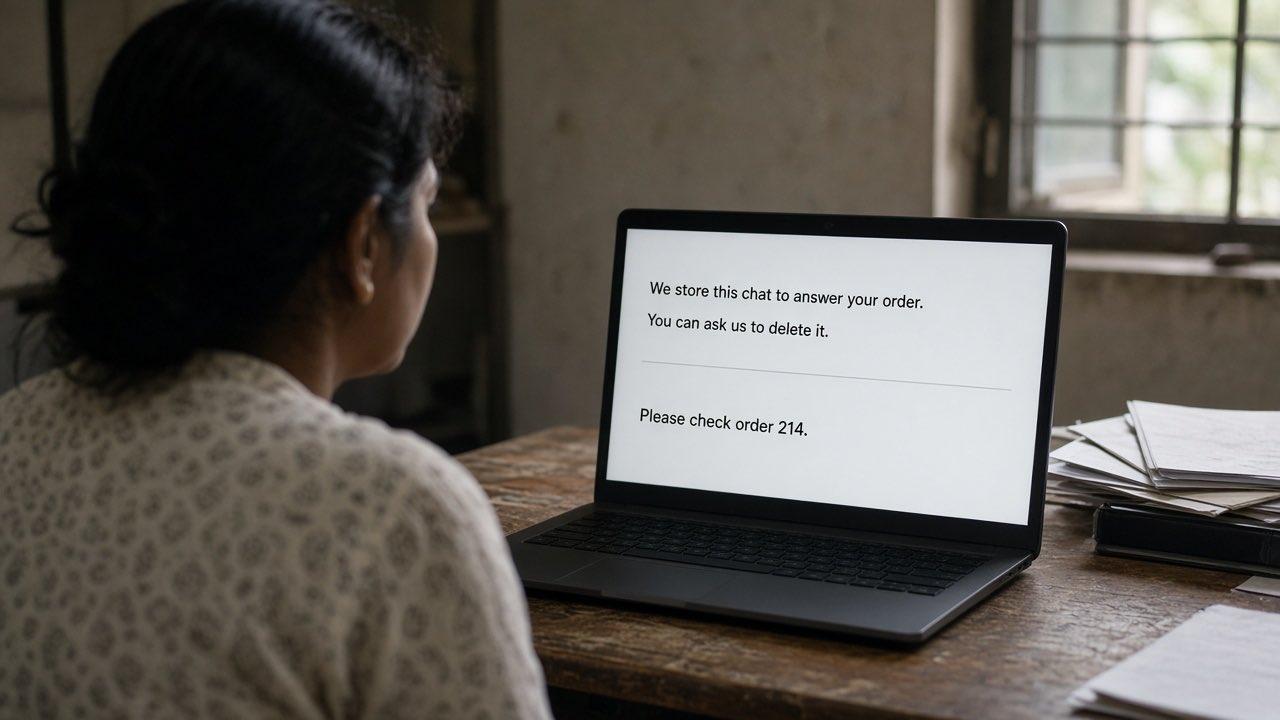
In a chat, that notice is a message the person sees before the bot asks for the resume, the order, or the phone number, not a link in a footer they never open. A recruitment chatbot is the worked example: the notice comes before the file, the role is the purpose, and a later opening is a new purpose. The same shape fits a support bot or an order bot. How data is handled when you add AI features covers the separate question of what the model provider does with the text you send it.
The DPDP Rules, notified on 13 November 2025, set out the notice and the phased dates. The Press Information Bureau described the principles the Act is guided by, including consent, purpose limitation, data minimisation, storage limitation and accountability. Most of the business duties start later in the phase-in. Confirm which date applies to your processing with your adviser, and do not wait for the date to write the notice. A chatbot build should include the notice in the script, not as a policy page added afterwards.
Who else sees the transcript, and how long do you keep it?
Decide this before launch, in writing. Your staff who handle the chat, the software that stores the log, and any model provider the reply is sent to are all part of the processing. A vendor who stores or sends the chat on your behalf is a Data Processor, and the Act says you engage a processor only under a valid contract. The contract should say what they store, whether they use it to train a model, and how you delete it. An insurance chat adds a second rule on top: IRDAI's limits on sharing details with third parties. Health reports are the sharpest case, and how to send lab reports on WhatsApp safely applies the processor contract, consent and breach steps to a lab. Accuracy is a separate duty from privacy; see is a business liable for what its chatbot says.
Storage limitation means you keep the chat for the purpose you named and then delete it. 'We might want it later' is not a purpose. Write a retention period next to the purpose: the hiring decision, the open order, the support case. When that ends, the transcript goes. The person also needs a way to withdraw consent and to ask what you hold. A human has to be able to find the thread and remove it. A log nobody can search is not a process. A CA firm collecting PAN and Aadhaar on WhatsApp shows the same rule applied to identity documents. For a clinic, the medical-records rules set how long the clinical file stays; see how long a clinic should keep patient records.
Can you reuse old chats for a new offer or to train a model?
Not on the strength of the original notice, if the original notice said you would answer this question or take this application. A festival offer, a new role, or a model trained on the archive is a new purpose. Section 6 limits consent to the specified purpose. You ask again, with a new notice, or you do not do it.
Training is the one teams skip past. If the model provider's business terms say customer content may be used to improve the model, that is a purpose you have to have told the person about, or a setting you have to have switched off in a business account. Check the terms of the account you actually use. A personal chat login and a business API key are not the same terms. Write the answer into the handover of the bot, next to the notice text.
Before the bot stores a chat
- The purpose is one sentence a customer can understand
- The notice appears in the chat before the data is asked for
- Your adviser has read the notice
- The processor contract covers storage, training and deletion
- A person can find a thread and delete it when the purpose ends
Sources
Rules and guidance this answer relies on. Policies change, so check the current version before acting on it.