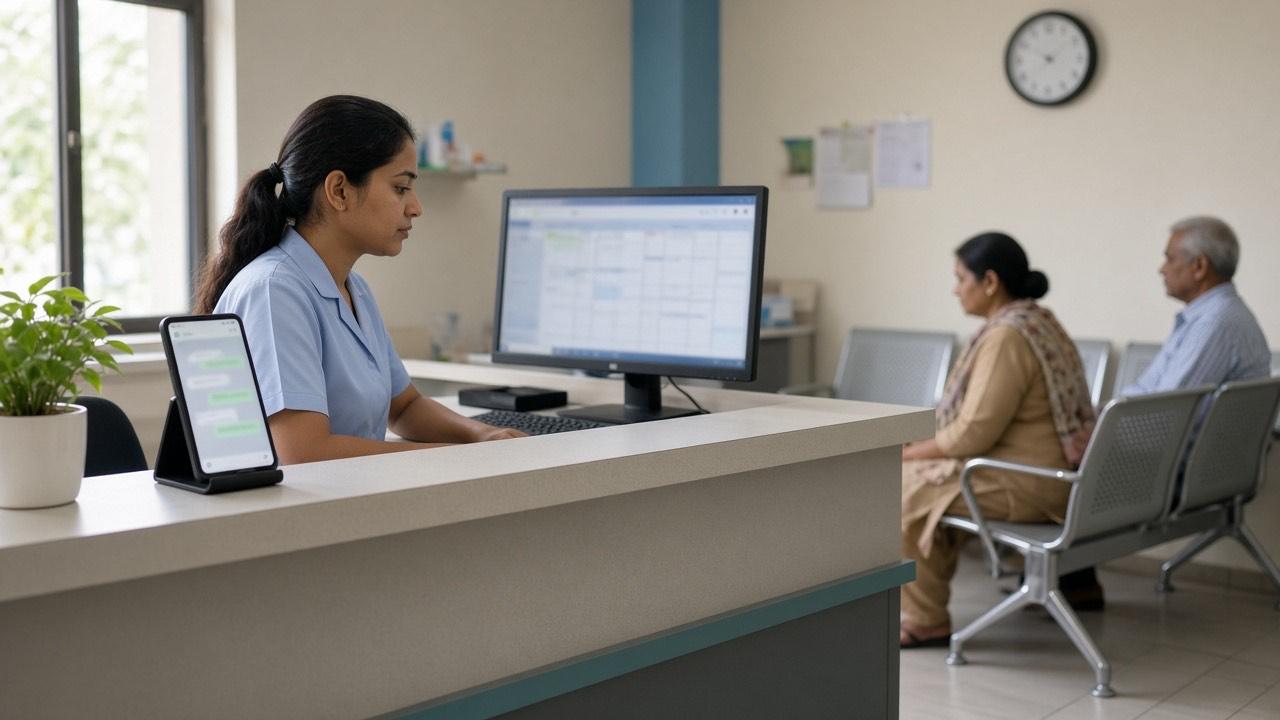
The key points
- The WhatsApp line handles administration; clinical questions go to the doctor by call or visit.
- Reports and prescriptions travel as expiring, verified links from the clinic system, not as loose PDF attachments.
- Reminders use approved, non-promotional templates and carry no health detail that a lock screen would show.
- NMC's 2026 guidelines name WhatsApp as a medium and bar solicitation, inducements and requests for patient reviews.
What should a clinic's WhatsApp line do?
Most clinics already run on WhatsApp, usually on the doctor's or receptionist's personal phone: patients ask for a slot, send old reports, ask whether the doctor is in today, and sometimes describe symptoms at midnight. Moving that onto one WhatsApp Business number with clear rules fixes three problems at once: patients get faster answers, the doctor's personal number stops being the clinic's helpline, and patient data stops living in a dozen personal chats.
The line does administration. Booking and rescheduling, reminders, directions and timings, the doctor's leave dates, fees as the clinic publishes them, report-ready alerts and access to signed prescriptions. It does not do consultations. If the clinic offers teleconsultation, that is a separate, deliberate service with its own records, not something that drifts into the reception chat. Whether you need the free app or the platform for this depends on volume and staff count, covered in the WhatsApp Business app versus the API.
How should booking and reminders work?
A patient writes, the bot asks for the doctor or speciality, offers open slots from the clinic's calendar, takes the name and age, and confirms. Changes and cancellations run in the same thread and free the slot. The calendar logic, buffers and double-booking checks are the same as in booking appointments with an AI chatbot.
Reminders go out the day before, which is usually outside WhatsApp's 24-hour reply window, so they must be approved templates under the WhatsApp Business Messaging Policy. Meta's template categorization guide describes utility templates as non-promotional messages triggered by a user's action or request, which is what a booking reminder is. Keep the reminder to the date, time, doctor's name, address and a reply option to reschedule. Leave out the reason for the visit: a phone's lock screen shows the message preview to anyone nearby.
How should reports reach the patient?
The common practice is to photograph or attach the report PDF in the chat. It works, but the file then sits in the patient's gallery and cloud backup, gets forwarded to relatives, and stays in the receptionist's phone indefinitely. A safer pattern sends a report-ready message with a link to the clinic's patient portal. The link opens only after a one-time code sent to the registered mobile number, expires after a set period, and records each access. The patient can still download the file; the clinic has simply stopped spraying copies across phones.
WhatsApp's own policy points the same way. It tells businesses not to use WhatsApp for telemedicine or to send or request health information where applicable regulations require systems that meet heightened standards for health data, and it bars sharing information from one customer's chat with another. India's Digital Personal Data Protection Act, 2023 requires reasonable security safeguards to prevent a personal data breach (section 8(5)) and notice of any breach to the Board and to each affected person (section 8(6)). A link with a code and an access log is far easier to defend under both than a PDF in forty chats. Confirm your retention and disclosure rules with your lawyer. The lab's version of this flow, from consent at sample collection to the report-ready template and the code-gated page, is in how to send lab reports on WhatsApp safely.
What about prescriptions?
A prescription is a clinical document signed by the doctor, so it leaves the clinic system as a link to the signed copy, exactly like a report. Reception staff never type medicine names or doses into a chat, and never answer whether the patient can take a tablet twice, switch brands or restart an old prescription; those questions go to the doctor.
Do not turn the clinic's number into a pharmacy counter either. The WhatsApp Business Messaging Policy prohibits using WhatsApp for Business to buy, sell or promote drugs, whether prescription or otherwise, and lists medical and healthcare products among the restricted goods. The clinic can tell a patient a prescription is ready to view; it does not take medicine orders on WhatsApp.
What must never be diagnosed or advised over chat?
Nothing clinical is decided in the chat: no diagnosis from a description or a photo, no reading of a report, no dosage change, and no reassurance that a symptom is nothing. The chatbot is built to recognise symptom descriptions and reply with one of two scripts. For red-flag words such as chest pain, breathlessness, heavy bleeding, fainting or a child with high fever, it tells the patient to call the emergency number or go to the nearest emergency department now, and alerts staff. For everything else it offers the earliest appointment or a call-back from the doctor.
Confidentiality sets the second boundary. The Code of Medical Ethics Regulations, 2002, published by the National Medical Commission, say in regulation 7.14 that a registered medical practitioner shall not disclose a patient's secrets learnt in professional practice except in listed circumstances. So the bot never discusses one patient with another number. A relative asking about a parent's report gets the portal process, which needs the code sent to the registered mobile.
What do NMC's 2026 advertising guidelines change for WhatsApp?
On 6 October 2026 the National Medical Commission issued Guidelines on Ethical Advertising and Public Communication for registered medical practitioners and medical institutions, in force with immediate effect. They name messaging platforms, WhatsApp and Telegram included, as a medium of advertisement. They apply to practitioners registered under the NMC Act and to hospitals and medical institutions; a dental practice should confirm with its adviser how its own council treats offers and review requests. The same guidelines also limit how a clinic pays a marketing agency, covered in should a clinic pay an agency per lead. For a clinic's WhatsApp line, four provisions matter:
- No inducements: discounts, limited-period offers, coupons, cashbacks, referral benefits or free procedures that encourage unnecessary consultations or tests are barred. Fees may be stated factually.
- No review or testimonial requests: practitioners shall not request or share patient testimonials, endorsements or reviews for professional promotion on social media, and shall not procure fake or paid reviews.
- No AI-generated promotional campaigns for commercial interest, and any permitted AI-generated content must be marked as AI.
- Permitted announcements stay permitted: starting practice, a change of address or type of practice, temporary absence, resumption, and a public declaration of charges, along with health-awareness messages that do not promote the practice.
How should consent and opt-in be collected?
Collect WhatsApp opt-in at registration, on the form or the front-desk tablet, as its own tick box separate from treatment consent. The WhatsApp policy requires opt-in before you message a patient and requires every stop request to be honoured, on or off WhatsApp. Under the DPDP Act, consent must be free, specific, informed and limited to the data needed for the stated purpose (section 6), and the patient must be offered the notice in English or any language in the Constitution's Eighth Schedule (section 5(3)), so a Telugu or Hindi version sits alongside the English one. The chat-storage side, including how long transcripts are kept, is covered in what DPDP means for a chatbot that stores chats. How long the clinic keeps the patient record itself is covered in how long a clinic should keep patient records.
How does a shared staff inbox keep it under control?
One business number, several staff, each with a role. Reception sees appointments and general questions. Only staff the doctor authorises see report and prescription threads. Every chat has an owner, unanswered chats escalate after a set time, and a staff member who leaves loses access the same day, with every conversation still in the clinic's account. Personal phones stop holding patient chats. The set-up, from the inbox tool to routing rules, is in sharing one WhatsApp Business number across a team.
How does Softivum set this up for a clinic?
We build the line on the WhatsApp Business Platform with an AI chatbot that books, reminds and answers administrative questions from the clinic's own timings and fee list, and hands every clinical message to staff. Workflow automation connects it to the clinic's calendar and records system, sends report-ready and prescription-ready links, and logs opt-ins and stop requests. The WhatsApp account, the patient data and the portal stay in the clinic's name. Other clinic and practice builds are on our healthcare and dental page.
Clinic WhatsApp messages: how each is sent and what it never contains
| Message | How it is sent | Window or template | Never include |
|---|---|---|---|
| Booking confirmation | Bot reply in the patient's thread | Inside the 24-hour window | Reason for visit |
| Appointment reminder | Scheduled from the calendar | Approved utility template | Symptoms, diagnosis or test names |
| Report ready | Link to the portal, opened with a one-time code | Utility template | The report itself or any result |
| Prescription ready | Link to the doctor-signed copy | Utility template | Medicine names or doses typed by staff |
| Doctor on leave or new address | Announcement to opted-in patients | Approved template | Offers or promotional claims |
| Symptom question | Bot script: emergency advice or a doctor slot | Inside the 24-hour window | Any diagnosis or reassurance |
| Discount, camp offer or review request | Not sent | Not applicable | Barred by NMC's 2026 guidelines |
Before the clinic's WhatsApp line goes live
- One WhatsApp Business number replaces personal phones for patient chats
- Opt-in is a separate tick at registration, with a notice in the patient's language
- Reminder templates name the date, time, doctor and address and nothing clinical
- Reports and prescriptions go as expiring links that open with a one-time code
- The bot routes red-flag symptoms to emergency advice and alerts staff
- No offers, discounts, health-camp promotions or review requests are scheduled
- Staff roles limit who sees report and prescription threads
- Access is removed the day a staff member leaves
Sources
Rules and guidance this answer relies on. Policies change, so check the current version before acting on it.